Description
Molar mass: 291.29 g/mol
pH: 9–10
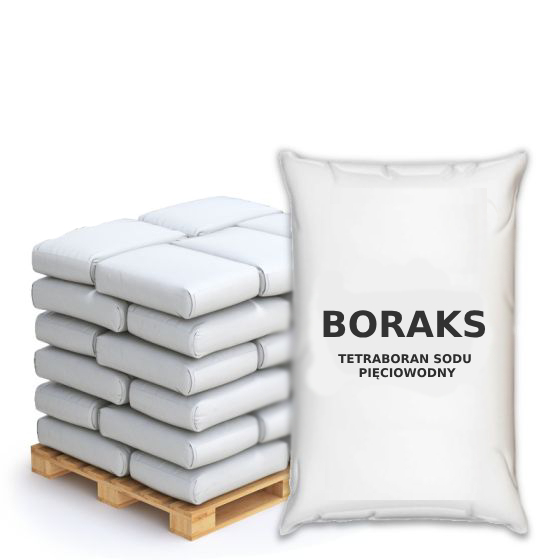
Borax pentahydrate (sodium tetraborate pentahydrate) is an inorganic chemical compound belonging to the borate group. Its chemical formula is Na₂B₄O₇·5H₂O. It occurs in the form of white, colorless crystals or granules that are well soluble in water. Borax is a natural mineral that can be found in dried soda lakes and can also be obtained synthetically through the reaction of sodium borate with water.
It is a substance with a slightly alkaline reaction, which means it exhibits buffering and pH-stabilizing properties. Borax has wide application in various branches of industry, from glass production to cleaning agents, agriculture, and cosmetics. It is also known for its antiseptic and antifungal properties. Borax pentahydrate is obtained mainly from natural borate deposits such as kernite and tincal. Its production process involves extraction and purification by dissolving in water and controlled crystallization.
On an industrial scale, borax can also be synthesized through the reaction of sodium carbonate (Na₂CO₃) with boric acid (H₃BO₃). This reaction leads to the formation of sodium tetraborate, which is then hydrated to form borax pentahydrate. Depending on reaction conditions, different hydrated forms of borax can be obtained, including borax decahydrate (Na₂B₄O₇·10H₂O).
Borax pentahydrate is more thermally stable than its decahydrate form, which makes it more frequently used in industry. The high solubility of borax in water facilitates its use in various chemical processes.
MARKET
Borax is widely used in various industries, and its main producers are countries with rich boron deposits, such as:
Turkey – the world’s largest supplier of boron and its compounds,
United States – an important market player,
South America – growing production share, particularly in Argentina,
China – one of the key consumers and producers of borax,
Russia and Kazakhstan – smaller but significant sources of boron extraction.
The global borax market maintains stable demand, especially in the detergent sector, fertilizers, glass industry, and metallurgy. The ecological industry is also playing an increasingly important role, seeking natural and safer chemical substitutes, which further drives demand for borax.
APPLICATION
Borax pentahydrate is used in the production of glass and ceramics, as a component of detergents and cleaning agents, in agriculture as a source of boron in fertilizers, and in cosmetics and pharmaceuticals due to its antiseptic properties. It is used in metallurgy for soldering and welding, in the wood industry as a protective agent, and in households for insect control, water purification, and mold removal.
PRECAUTIONARY MEASURES
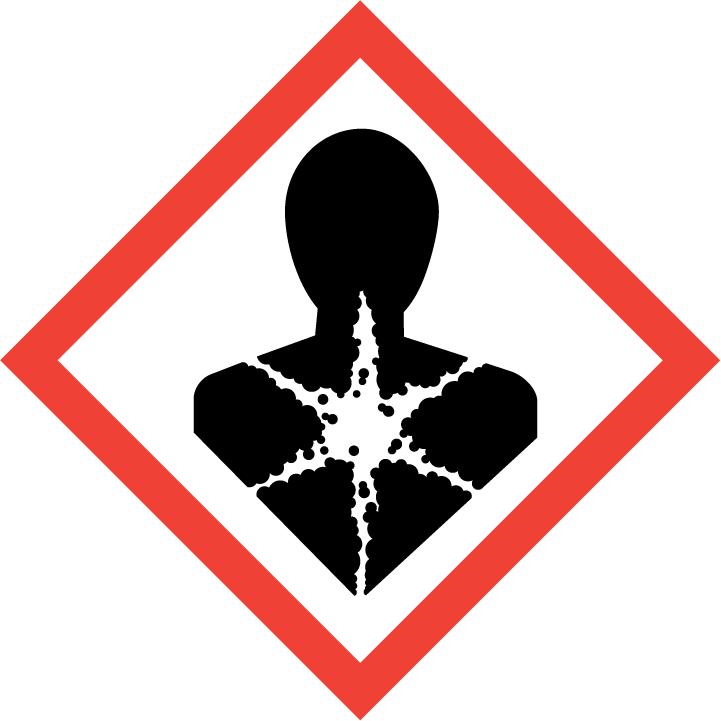
According to Regulation (EC) No 1272/2008 (CLP), borax pentahydrate is classified as a substance that: “may damage fertility and the unborn child”, “causes eye irritation”, and “may cause skin irritation after prolonged contact”.
| Category | Description |
|---|---|
| General notes | Do not leave the injured person unattended. Remove the injured person from the danger area. Ensure rest and warmth. Immediately remove all contaminated clothing. In case of any doubts or persistent symptoms, consult a doctor. In case of unconsciousness, place the person in the recovery position. Do not give anything orally. |
| After inhalation exposure | Remove or carry the injured person to fresh air. Ensure breathing comfort. In case of cough, breathing difficulties, or respiratory irritation, consult a doctor. |
| After skin contact | Rinse skin with plenty of water. Remove all contaminated clothing. In case of skin irritation, contact a doctor. |
| After eye contact | Immediately rinse eyes with plenty of clean running water for at least 10 minutes, keeping eyelids wide open. If the injured person wears contact lenses, remove them if possible. Continue rinsing and consult an ophthalmologist. |
| After ingestion exposure | Rinse mouth with water (only if the injured person is conscious). DO NOT induce vomiting. Seek medical advice immediately. |
| Indications regarding any immediate medical attention and special treatment | Symptomatic treatment. In case of ingestion, monitor the injured person’s condition and seek medical assistance. |
HAZARD CODES
| Category | Code and description |
|---|---|
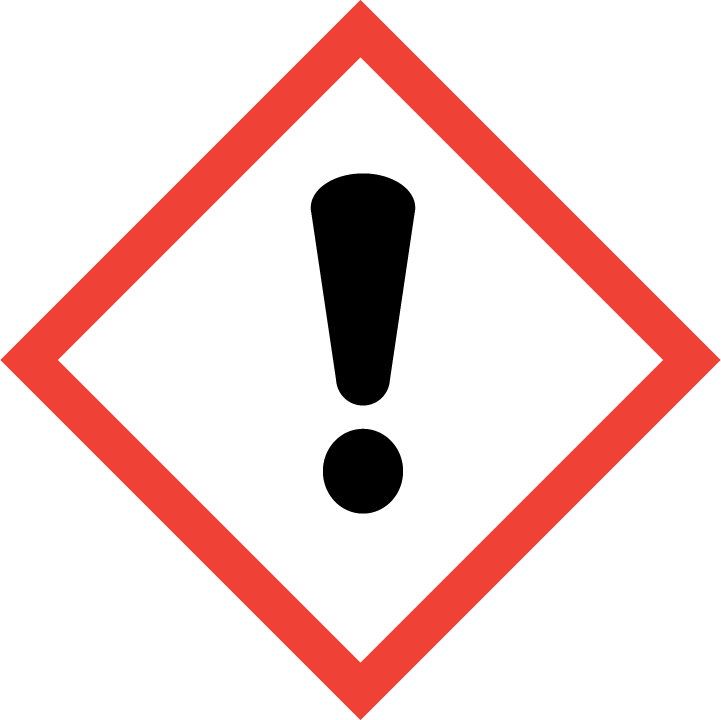
| Hazard statements | H319 Causes eye irritation. H360FD May damage fertility. May damage the unborn child. |
| Precautionary statements | P201 Obtain special instructions before use. P202 Do not handle until all safety precautions have been read and understood. P280 Wear protective gloves/protective clothing/eye protection/face protection. P305+P351+P338 IF IN EYES: Rinse cautiously with water for several minutes. Remove contact lenses, if present and easy to do. Continue rinsing. P308+P313 IF exposed or concerned: Get medical advice/attention. P405 Store locked up. |